Showing posts with label Blog. Show all posts

Thursday, May 22, 2008

Infoaesthetics & Data Visualisation: The Expressivity of 'Virtual' Matter Itself

Information Aesthetics: Form Follows Data - Data Visualisation & Visual Communication (Infoaesthetics) is a blog dedicated to exploring the symbiotic relationship between creative design and the field of information visualisation. Inspired by Manovich's definition, infoaesthetics relates to a series of new conceptualisations of form - emergent, distributed representation that is never fixed, within the set of parameters within software. (Data is to informationalism, what abstraction was to Modernism).


Bus Routes Data Sculpture - a 3D data sculpture of the Sunday Minneapolis / St. Paul public transit system, where the horizontal axes represent directional movement and the vertical represents time.


Infoaesthetics functions like an exhibition or art space, a project that has collated many different data collections & representations, such as the virtual mapping of human movement through space. As a blog, it is interested in data representations that acknowledge the importance of the emotional experience of users as information access is becoming increasingly ubiquitous in our daily lives and therefore new approaches are required for information presentation which consider user engagement and visual aesthetics.


greenpix zero-energy massive LED display - the largest color LED display worldwide, & the first photo-voltaic system integrated into a glass curtain wall in China. the display requires zero external energy, as the facade harvests solar energy by day & uses it to illuminate the screen after dark.

Following a Deleuzian populist approach to art - artistic production, extended to include all forms of expressivity and creativity, is a capability of many more things in the world than humans or a specific group of humans - atoms, molecules, geological phenomena, animals. It also includes the expressive representations of visual data and the circulatory or distribution processes that create these emergent forms.

Wifi Geographical Mapping - a set of "semi-abstract" circular visualizations of the WiFi encryption levels while traveling through the cities of London, Vescemont, Belfort & Barcelona.

Monday, May 19, 2008

Not All Bloggers Are Human...

Written by artist Eugenio Tisselli, JB Wock is PHP script who likes to keep a blog.

Posting nearly as regularly as each day, JB Wock's decision to post is determined by a random vairable, not disimilar to human bloggers who post based upon contingent factors or establish ritualistic posting procedures, often based upon contingent factors.

JB Wock finds phrases on the internet and manipulates this found text, 'twisting' it into something different - but still derived from a source text. The readers of this blog leave comments that riff off the short, poetic lines JB Wock posts. The recursiveness of leaving comments on others' blogs, as an intrinsic part of any blog's functionining, is heightened in this project.

I wonder if We Feel Fine has picked up on how this alogrithm is 'feeling'?

Thursday, May 15, 2008

"Eye Candy For The Style Hungry" - Well, Its Certainly Got Me Wanting More...


Along with all things sweet, spending time each day pouring over fashion blogs - a new-found wealth of imagery, has become a new found love, some might similarly call an addiction - although would have to admit (depending upon my chocolate consumption) - both are harmless variations.

The impetus appears to be strong. There are so many amazing photographic projects undertaken by creative individuals - who post, sometimes as frequently as daily, results of their street fashion scouting online. I am struck by the diversity of approaches to the internet as an expressive medium for exhibiting the fashions of particular stylish people - resulting in blogs like Facehunter, HelLooks, Satorialist, becoming distinct social media objects - individuated from one another, each blog having its own identity.


This is apparent in not only the "kinds" of individuals that are chosen to be photographed (presumably, unless there is a call for people to send own photographs in, the blogger's attention will be captured by not everything, but a certain something), but also in the very way in which the blog is "present" within the diverse actual-virtual ecology that is the internet. The blogger must make particular editing decisions - actively controlling the expressive elements on the site, for instance how a user navigates, the layout, relationship between text and images, and associations/community listed in a sidebar.


Following Gell, who examines the social context as art - the production, circulation, and reception, rather evaluating art upon whether it is of aesthetic value or some other merit - like innovation or originality, an examination of the social context of fashion blogs is an appropriate way to examine these blogs as art. While there are evaluations of blogs upon the basis of aesthetics or sophistication, (this site here is an example, although I must say I appreciate their focus on independently produced blogs), it is perhaps more interesting or suitable to examine the ways in which certain social processes have brought about the production and circulation of fashion blogs, and would better explain why the internet has been used for this type of social and creative activity.


I have noticed fashion bloggers are commonly preoccupied with exhibiting the images they collect from a particular city, usually the one they live in. However Facehunter is seen to travel across the Continent and to North America even, collecting images for his now, extremely well-known, blog. Perhaps fashion blogs are a new way to "image" the city or a new form of urban art?


Examining the social context as art, allows us to evaluate why street fashion blogging and photo sharing between geographically distant cities has become so popular in the last few years, and enables an appreciation of the diverse creativity and expressivity found online.


The above images are some of my favourites all taken from Facehunter archives.

Monday, April 21, 2008

Post(Your)Secret(s)... And they will remain confidential...


A postcard is an easily identifiable and recognizable social object, distinguished by its regularized size, flatness and double-sided appearance (one side usually presents a visual image of some sort, and on the other a blank space where a message or note is typically written). Sharply contrasted with the expansive format of the letter, a postcard offers scope for brief and compressed linguistic expression. Envelope-less, a postcard is the perfect choice for sending a souvenir whilst on travel (which has been its normative historical function). The postcard, along with letter writing has been replaced by the enabling speedy and efficient capabilities of email and internet communication that which manages to circumvent the postal service altogether.


Accompanied by a precarious art history of its own (eroticized dusky maidens enticing visitors to a South Pacific paradise come to mind as one of many examples), the postcard, has also been exploited for commercial art purposes. Most galleries and museums now cheaply reprint, the most well-known and iconic canonical art images, from Monet to Warhol, onto postcards and make available for purchase.


This is at odds with the use of postcards for the artistic trading activities and processes of exchange that characterized the international mail art network and movement beginning in the 1950s & 60s. Via the postal service, artists gifted and received a multiplicity of ephemera. Ranging from postcards and handmade books or zines to images made from photocopied materials or with rubber stamps, and other found objects and materials usually relegated to the margins of artistic productivity.

(Useful resources for mail art online - Mail-Art, International Mail Art Archives, EMMA)

Based upon ideas surrounding of freely exchanging art objects and critiquing the dominance of art institutions, mail art “focuses [up]on the social context of art production, circulation, and reception, rather than the evaluation of particular works of art” (Gell 3). This focus is closely linked to a contemporary community art project that similarly makes use of postcard format. PostSecret is an ongoing community art project where people mail in their secrets anonymously on one side of a homemade postcard to a postal address. From here they are "posted" onto the PostSecret blog (blogging and mailing postcards as two forms of "posting"). Sharing secrets has extended to artists using video formats and book publications of the collected postcards.

PostSecret is a mixed reality work. Real life experiences and activities, transferring a deep dark secret onto a postcard, are mixed with the virtual activities of, posting the postcards onto the blog itself and users experiencing the art project online. Exposing secrets to wide internet readership and constructing secrets, literally reifying that which is essentially considered to be a ‘feeling’, ‘regret for past action’, or a ‘worry’ into a concrete object, are expressive and "performative" processes, resulting in the production of a vast range of social media objects.


From the humorous and trifling …


... to a confession of either superficiality or desperateness

... to a statement of guilt, perhaps commenting further (and maybe beyond the creator's intention) on the effects of political correctness and the ways in which marginal groups are socially "visible".
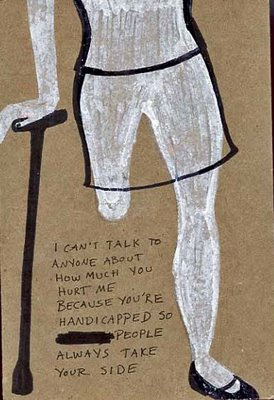
If a secret is understood as that which is kept hidden from knowledge or view, that which we kept internalized, concealed, and do not express, our very notion of ‘secret’ or ‘secretness’ must shift when a secret is shared between individuals or materially expressed in some way. The intrinsic format of the postcard makes a posted secret constantly in visible. It cannot be concealed at any stage of the circulation process, between its initial creation, postal processing and reception on the internet.


And yet these "secret-spillers" remain anonymous. Evading vicious gossip discourse, the project protects its creators by making it impossible to discover their identity. But because secrets have been shared and exposed this potential curiosity seems to be already in effect satisfied. Perhaps more importantly considered is the nature of the ‘secret’ itself and our notions of ‘secretness’. Is a secret still a secret when it is expressed and shared with a large audience?


PostSecret writes that “Sometimes a secret we keep from ourselves only becomes true after we read it on a strangers postcard.” The capabilities of social agency instantiated by the project goes beyond the creator’s intention (Gell 3) to perhaps simply "get something off their chest." Reading the secrets of others can potentially make us realise that we perhaps hold that secret too.


Works Cited

Gell, Alfred. Art and Agency: An Anthropological Theory. Oxford : Clarendon Press, 1998.